The recent announcement of the Prisma Illya finale anime inspired me to sit down and read the Prisma Illya manga. The 2010s anime adaptations were a fun but not terribly impressive mahou shoujo loli yuri romp. Maybe, like so many other properties, Prillya suffered substantial adaptation decay when it was converted to an anime? There was only one way to find out.
Turns out that yeah, the Prillya manga is incredible and the anime adaptations don’t do it any justice. It blew me away with its mixture of rich storytelling and classic mahou shoujo charm. I want to encourage others to give the Prillya manga a chance too, and I figure the best way to do that is to write a review. If this tickles even one person’s brain into reading Prisma Illya then I’ll be pretty happy with myself.
It’s somewhat difficult to write a proper review for Prillya because it isn’t finished yet. The ending is near, the trajectory for the finale is firmly set, and mangaka Hiroyama Hiroshi has a crystal clear vision for the story. Yet it’s still not obvious what kind of emotional and thematic climax is waiting for us at the end.
I’ll try anyway. Prillya is the soul of Nanoha, mixed with the blood of Fate, delivered by an incredibly talented mangaka and storyteller.
If you’re reading tanoshimi then you’re almost certainly quite familiar with Fate. You also probably have some knowledge of the basic concept of Prisma Illya. You know, alt universe Illya becomes a mahou shoujo, meets another mahou shoujo named Miyu, and hijinks ensue. You’ve seen the gifs of Kuro making out with Illya and Miyu. I know you have. That’s good, it saves me the trouble of having to explain any of that stuff. This review is long enough as it is.
Prillya’s setup is heavily inspired by Nanoha. It’s got the same kind of mahou shoujo purity, it even likes to describe Illya as a 普通の女の子. When faced with adversity she strives for outcomes of friendship and understanding. Her goal is to save everyone, no matter how dire the circumstances (this is a Fate story, so it gets quite dire). Perhaps this kind of goal is little more than 少女のわがまま, but what is mahou shoujo if not the incarnation of 少女のわがまま? Right, mahou shoujo is also high octane action with girls flying around in the sky shooting energy beams. It’s got that part of Nanoha too. Hell, the reason Miyu exists in the first place is because Illya needed a dark mahou shoujo counterpart who would become her girlfriend. You know, just like Nanoha.
What I’m saying is that if you’ve been craving a high quality story in the vein of classic Nanoha, then Prillya might just be the work for you.
At the same time, Prillya is deeply rooted in the worldview and storytelling conventions of Fate. As outrageous as Prillya’s universe might seem at times, it’s really only separated from the prime F/SN universe by a couple characters making a different choice. It offers a rich thematic examination of that Fate classic 正義 in a world where no one agrees on what “the right thing to do” truly entails. It’s not clear what Illya’s goal of saving everyone even means for some of these characters! Prillya’s other major theme is an exploration of identity. What does the concept of one’s identity mean when every person is constantly changing, constantly gaining and losing things that are important to them? Prillya comes up with some fascinating ways to pick at this subject, and it ultimately leads to what I consider the primary thesis of the series:
Just who is Illya? Shirou’s loli imouto? Miyu’s girlfriend? Kiritsugu and Iri’s daughter? A cunning and at times ruthless homonculus? A living holy grail? A tool created to be callously expended for someone else’s purpose? Just an ordinary girl trying to live a happy life with her friends? Maybe even a mahou shoujo? Ask any Fate fan and you’ll probably get a different answer. This question is not shoved in the reader’s face. It only crystallized in my head after reading 21 tankoubon and then seeing misguided commentary complaining that Prillya is a gross flanderization of F/SN Illya’s character. I realized in retrospect that the question of Illya’s identity quietly pulses beneath the entirety of Prillya’s run, and it will be a pivotal component of its finale.
This Fate blood and Nanoha soul wouldn’t matter if creator Hiroyama Hiroshi didn’t bring the sauce. And man, does he ever bring it. Hiroyama is an incredibly talented mangaka. Prillya is chock full of dynamic paneling and evocative layouts that perfectly match the mood of every sequence. The character art is rough at first but becomes beautiful and emotional in the latter half of the series. The storytelling is driven by narration and dialogue that is witty, fresh, and increasingly lyrical and poignant as the series goes on. By 3rei Prillya begins to truly feel like an eroge in manga form, a story built equally as much on dialogue as it is on eloquent internal narration. While Prillya may not have the textual density of an actual eroge – it is a manga, after all – it often succeeds in capturing the feel of rich prose.
Hell, Prillya’s anime adaptations even fail in the same way as many anime adaptations of eroge. Forced to cut so much text that key scenes lose all impact, shaky production values that cannot match the evocative artistic composition of key manga layouts (ruby: CGs), and poignant character arcs and thematic throughlines getting totally lost in the shuffle. At least the loli fanservice in the anime is good. That’s something. It actually takes Hiroyama quite a while before he can draw a really hot Illya and Miyu but don’t worry he gets there. Really what I’m saying here is that the Prillya manga is worth checking out even if you weren’t impressed by the anime.
The Prillya manga doesn’t launch at these lofty heights of quality. Back in the mid 2000s Hiroyama was just a Fate doujinshi artist who was personally scouted by Nasu and Takeuchi to create a two tankoubon Fate spinoff manga. Hiroyama pitched a basic mahou shoujo Illya concept expecting it to get rejected, and here we are some 20 years later. While those early Prillya tankoubons do not have the depth or polish of what 3rei would eventually become, the series is still engaging from the get go thanks to Hiroyama’s witty dialogue, energetic visuals, and what I can only describe as doujin shitpost spirit. Prillya was unexpectedly continued with 2wei, which immediately lays the groundwork for more serious longform storytelling. While I don’t know what circumstances led to the transition from 2wei to 3rei, it is the latter where Prillya really takes off. 3rei gives Hiroyama the space to cut loose. His raw talent (Nasu made a good scouting decision!), refined by years of regular manga serialization, is given the freedom to pursue a story with ambitious depth and world building. The result is a story worthy of bearing the Fate brand while remaining faithful to its mahou shoujo inspirations. It’s a delicate, delectable balancing act.
So yeah I’ve been extremely impressed by the Prillya manga. It gets my highest recommendation for fans of Fate and fans of 2000s Nanoha style mahou shoujo. And for all the Illya fans out there, it’s the Illya route that Fate never had (kind of). I can’t wait to see how it ends. I’m pretty sure that Hiroyama is going to nail the landing.
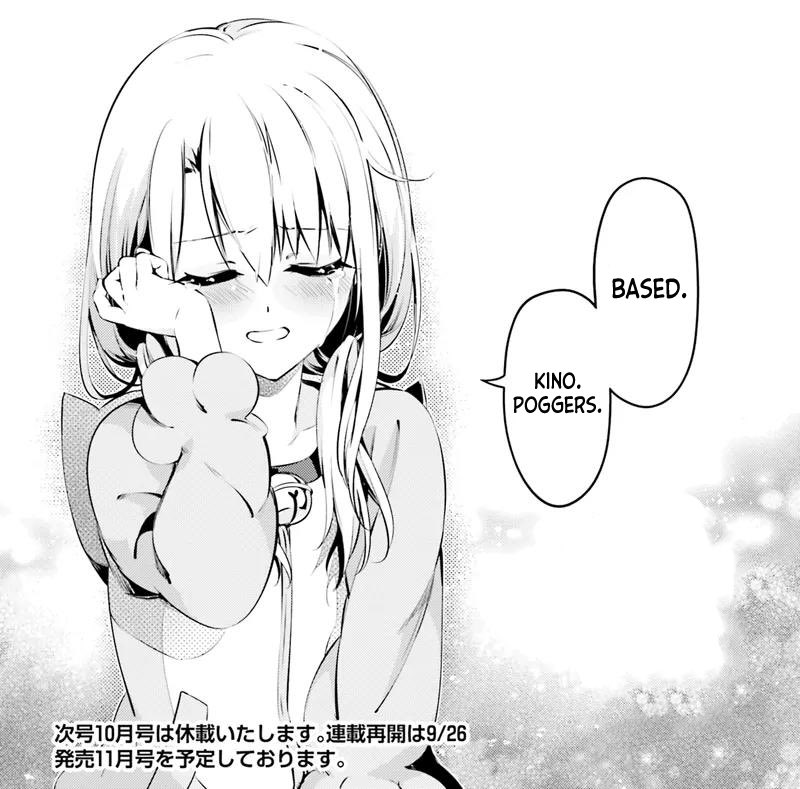
If you’ve ever seen this classic Illya meme and wondered what she’s talking about, well now you know. Illya is talking about the Prisma Illya manga itself.